| Copyright ©2001-2023 Tuner Information Center. Permission is hereby granted to quote our text so long as proper credit is given. eBay listings that quote us incorrectly or without credit may be terminated without notice. This site contains affiliate links for which we may be compensated.
Tuner Reviews O-R
Tuners are listed alphabetically by manufacturer and in alphabetical and numerical sequence by model number. In parentheses after the model number are the year of introduction and most recent list price, and/or the original list price if indicated by "orig" (special thanks to David Rich of The Audio Critic for copies of historical material from his reference library). Please see the On-Deck Circle for tuners that we know very little about or that we're not sure merit a writeup.
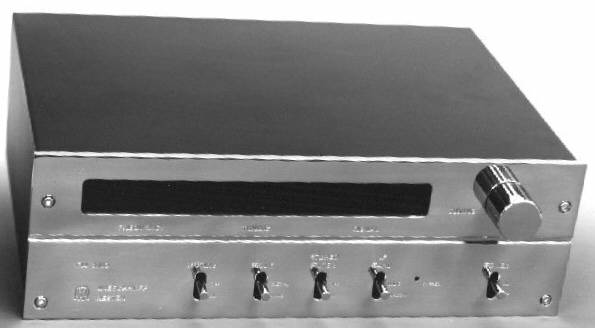
Onix BWD-1 (front, with power supply, back) search eBay
A longtime favorite of our knowledgeable contributor doug s., the BWD-1 is a very rare and pricey minimalist FM-only tuner. We've only seen a few of them offered in the secondary market since 2001, usually between $275-550, and usually sold together with a "SOAP" power supply unit. Please post in our FMtuners group if you've ever used a BWD-1.
Onix TU39 search eBay
Jim was our only panelist who ever saw a TU39. See how one sample sounded compared to other top tuners on our Shootouts page.
Onkyo Tuners can be found on a separate page.
Optonica search eBay
Optonica was the brand name for high-end electronics manufactured by the Japanese giant Sharp from 1976 to 1981 or so. They did not get much respect from high-end dealers in the U.S. at the time, and their tuners are now generally scarce in the secondary market.
Optonica ST-3535 (1977, $270, front, inside) search eBay
Our panelist Ray reports: "I've had some time playing with a recently obtained Optonica ST-3535 and its service manual. I was hoping it would be an ST-3636 sans 'Opto-Lock' but, alas, it's also sans a few more things. It has 4 FM gangs, one IF bandwidth, 2 ceramic filters (though one is a double), and the darndest 'tour de force' audio stages I've yet seen. The AM section has 3 gangs but even when aligned, it's not very sensitive. The FM front end has dual-gate FETs. The IF section has a transistor amp, the dual-section CF, IC amp, single CF, and then two IC amp stages. Optonica/Sharp did their IC shopping at the Hitachi store as the MPX chip is an HA1156 and there's an HA1149 dual audio amp. Here's how the audio section stacks up: HA1156 MPX out to single transistor amp/buffers to dual LPF/notch filters to discreet de-emphasis filters to a dual audio amp IC. That drives the fixed out jacks through 8.2K--12K dividers. But wait, there's more! For variable outputs it runs through pots which then feed emitter follower buffers, then to the jacks. WHEW! That's a lot of stuff. The ST-3535's specs: mono sensitivity 13.2 dBf; image rejection 80 dB; IF rejection 85 dB; spurious response rejection 80 dB; capture ratio 1.5 dB; alternate channel selectivity 65 dB; THD mono .40%, stereo .80% w/separation at 34 dB; FM frequency response 45 Hz to 13 kHz +/- 1.5dB (measured response was -1.0 dB at 30 Hz, +.2 dB at 12 kHz and -1.4 dB at 15 kHz). I found the ST-3535 to sound quite good with a big clean signal, but the ST-3636, with its 'Opto-Lock' defeated, is a far better tuner. In RFM's tuner comparison setup the similarly equipped (4 gangs, 3 CFs) digital Hitachi FT-5000 was easily superior to the ST-3535 at station-getting. The ST-3535 is a great-looking '70s big box with its lime-green light show. RFM's opinion? Remove this one from your shopping list; there is better 'sparrow feed' to be had." The ST-3535 usually sells for $30-50 on eBay.
Optonica ST-3636 (1978, $300) search eBay
Our panelist Ray says his research revealed that the ST-3636 is "an earlier all-analog version of the ST-7405." It has 5 FM gangs and 3 AM gangs, wide and narrow FM bandwidth settings, fixed and variable output jacks and a 400-Hz tape calibration tone, but unfortunately also has the overactive 'Opto-Lock' circuitry described in the ST-7405 writeup below. Ray and our panelist Bob speculated that the ST-3636, with 3 narrow filters and 3 IF amps, may be a good performer when modded, particularly for DXing once the lock is defeated. Here's Ray's subsequent report: "We put the ST-3636, sans Opto-Lock, into the tuner shootout system last night. It sat between the TX-9800 and the RFM-815 [modified KT-815 - Editor]. It got whupped! A 21 KW signal from 143 miles away was stereo/narrow listenable on the TX-9800, mono/narrow listenable on the RFM-815 and... no reception at all on the ST-3636. On bigger signals, the ST-3636 sounds similar to the Pioneer, but a little lean compared to the modded Kenwood. I've since removed the antenna circuit balun, which moved the S-meter up about half a pointer's worth. These are all 5-gang tuners, so I expected better from the Optonica. Bob suggests that it needs tweaking up front, and that will eventually get done. Next, though, it gets a matched set of filters from Bill Ammons. It has 4 280s stock, but will get two 280s and a 150 in narrow plus another 280 for wide/narrow on advice from Bob." After having been tweaked by Ray and aligned by Bob, Ray's ST-3636 was reviewed by our panelist Jim on the Modified Tuner Report page. The ST-3636 seems to be fairly common on eBay and usually sells for $25-60.
Optonica ST-4405 (1981, $250) search eBay
The ST-4405 is an uncommon 4-gang FM-AM tuner that was the baby of the ST-9405/ST-7405 line. It had 5-LED signal-strength and 3-LED tuning meter displays, an air-check calibrator, high blend, FM muting and mode switches, and fixed and variable output jacks. Sensitivity was good but other specs just so-so. The ST-4405 sells for $10-50 on eBay.
Optonica ST-4406 (1981, $260) search eBay
The scarce ST-4406 is another mystery that we're speculating may be worthwhile. Sharp's advertising material says: "AM/FM-stereo quartz PLL synthesizer tuner with quadrature detector. Features FM muting circuitry; auto tuning system; 10-station, 2-band presettable memory; microprocessor-controlled soft-push switches; air-check calibrator; digital frequency display; 5-LED signal-strength meter; hi-blend switch; 'last station' memory; LED function indicators and memory backup system." The ST-4406 usually sells for $10-20 on eBay.
Optonica ST-7405 (1981, $400) search eBay
Our panelist Ray reports: "I picked off an ST-7405 some months back just because it was cheap, had bandwidth selection, was an analog with digital readout, and I was curious. Well, to my astonishment, it has 5 FM gangs and 4 filters in narrow, has discrete outputs, and gives a very good account of itself compared to the better known/respected units in my stable. But I have been quite frustrated with Optonica's 'Opto-Lock' feature which is also found in their ST-3636. It's much too active, pulling in stronger signals and locking them from as much as 400 kHz away. Both tuners are 5-gangers with wide and narrow bandwidth settings, but the Opto-Lock negates all that selectivity potential and it's not defeatable via any front or rear panel controls. BUT, there is hope! Last night I lifted the collector of TR602, which is a switch for the Opto-Lock circuitry. From the bench, this seems to have rendered the ST-7405 'normal,' i.e., like pre-opto-synchro-whatever lock tuners. If you want a very good sounding and sensitive tuner that is easy to tune, the ST-7405 can be highly recommended. If you are a DXer, forget it unless you also like to D.I.Y." Ray did a DXing shootout among his ST-7405, a KT-8300 and a Pioneer TX-9800: "The TX-9800 won the pure sensitivity challenge, but not by as much as with most [over the KT-8300]. When I tested them for adjacent-channel performance, the TX-9800 and KT-8300 could both ignore the adjacent, but the ST-7405 had lots of interfering hash." Sharp's advertising material lists some other features of the FM-AM ST-7405: 7-LED signal-strength and center-tuning meter displays; multipath monitor switch; air-check calibrator; high blend; FM muting switch; mode switch; and fixed and variable output jacks. It also has one unswitched electrical outlet in the back. The ST-7405 is rare on eBay and usually sells for $25-55.
Panasonic ST-3400 (1973, $240) search eBay
The FM-AM ST-3400, which our panelist Ray thinks may have also been badged a Technics ST-3400, was Ray's "latest sparrow feed snag for a full $9.95. The first thing to catch the eye is the cute round dual meter. The lower one is standard fare signal strength but the upper serves as a multipath meter or a distortion null meter. Distortion null seems to serve the purpose of the usual center-tuning meter but the optimum is at full deflection. Inside we find 4 FM gangs in a, first for RFM, single tune - FET RF amp - single tune - FET RF amp - single tune - mixer. LOTS of RF gain and little tuned circuit loss. Yes, it is sensitive and, yes, prone to overload but in 1973 we didn't have so many big signals to ward off, did we? There are mounts for 4 ceramic filters but in this one CF1 was just a stock mounted cap. There is not a single IC to be found; everything is done with discreet transistor circuitry. The nicely lit dashboard takes 13 bulbs! It sports fixed and variable audio outs and a rather robust detector out that'll drive RFM's LM4500 MPX units just fine. Old and stock, it doesn't bring out the best in sound but it'll be easy to mod and flatten the curve and provide higher grades of caps. If you are in a more rural area and are not afraid to poke around with a hot iron this is one surprisingly good project tuner. And, several agree, it's very nice to look at." Our reference materials suggest that the ST-3400 was the little brother of the ST-3600, which had mostly identical specs but retailed for $60 more.
Parasound T/DQ-1600 (owner's manual) search eBay
The very common T/DQ-1600 was probably the best of the relatively inexpensive tuners manufactured by Parasound. It was recommended by Stereophile, but that's about all we know. Please post in our FMtuners group if you have any information about any Parasound tuner. The T/DQ-1600 usually sells for $60-150 on eBay, but prices can be all over the place.
Perreaux TU3 (Stereo Review review) search eBay
Perreaux designed some gorgeous and generally well-regarded modern tuners, but we'd never seen one in the flesh until Jim had a chance to play with a TU3: "The TU3 is an attractive thin-line FM-only tuner. The rack-mountable face is 19 inches wide by only 1-3/4 inches high. The color is a matte silver that reminds me of Conrad-Johnson's old Motif line of audio gear. The small frequency display window presents fluorescent blue numbers that contrast interestingly with a separate red LED signal level meter. The front has six memory presets, store, on/off and a stereo/mono muting switch. Tuning is done via a detent feel, round analog-type knob. Sweet and simple, turn on the music and listen. The rear has a three-way de-emphasis switch for 75, 50, and 25 µS. There is an IEC connection that looks stock. The inside is sparse but there are two power transformers and a more liberal than normal use of film caps around the audio section. The TU3 requires a PAL to F antenna adaptor." The adaptor required is female PAL to female F, such as Radio Shack part number 2780265. See how this one TU3 sounded compared to other top tuners on our Shootouts page. The TU3 usually sells for $120-255 on eBay.
Phase Linear - Phase Linear may be "The "Emperor's New Clothes" of tuner manufacturers, based on our reviews: big empty boxes, lots of lights, but very little substance. Two websites that once offered a more respectful view of the company's products, VintagePhase.com and Anthony Young's site at phaselinearhistory.com, are no more.
Phase Linear Model 5000 (1976, $580, photo) search eBay
The Model 5000 is a 5-gang, FM-only tuner with a very large cabinet in relation to its contents. Like the Model 5100 Series Two, the 5000 had only two ceramic filters. Our contributor Ryan says, "This tuner grossly overemphasizes the treble. Here's my theory: The 5000 has some sort of audio expansion circuit built into it, probably something akin to a DBX 1BX or something like that, and I don't think the thing ever switches completely out of the circuit, even when set to zero expansion. While some might like this expansion compared to a 'normal' tuner, I simply found it annoying after extended listening. Now, onto the reception: It's not great, but decent. There is no switchable bandwidth, but it is readily apparent that the tuner is engineered for middle-of-the-road performance tending more toward decent DX reception than local wideband performance. It never sounded terribly great on local stations, but seems to be quite selective. Beneficially, the stereo threshold seems quite low. Internally, the PL 5000 is a tuner on a bunch of chips with a face lit up like a candle. I've never seen so many fuse bulbs used to light up a face. There isn't hardly a discreet component in the thing: everything's on a chip, but most of them are actually socketed as opposed to soldered right on, so upgrades might actually be a fairly easy endeavor. Consequently, the tuner doesn't weigh a whole lot, and wastes a ton of space inside the chassis. I could have designed this thing on a breadboard from Radio Shack. So there you have it: If you want a built in expander, go for it. But be prepared for one of the strangest-sounding tuners you've ever heard. It's bright - really bright." Mike Zuccaro confirms that the 5000 is "one of the very few tuners that includes a volume expander, which helps a bit to 'un-compress' some of the over-compressed signals on the air." But overall, Mike agrees that the 5000 "is one big tuner, with surprisingly little inside - not one to go out of your way to pick up." The Model 5000 usually sells for $135-255 on eBay, with units with wooden cabinets tending to go toward the higher end of the range.
Phase Linear Model 5000 Series Two (1978, $580) search eBay
The FM-only Model 5000 Series Two (sometimes called the "5000II"), like the original Model 5000, has 5 gangs and two ceramic filters. Like the Model 5000, the Series Two has a dynamic range expander with 0 dB, 9 dB and 4 dB selections. This simple tuner, with its simple circuit, has a total consumption of 75 watts as listed on the back. Probably 60 of those watts are attributable to the 13 lamps! There is a dimmer switch on the rear for the lamps, along with adjustments for the smallish tuning meters. At the right front, there are 3 LEDs that indicate multipath. Their constant flashing can be quite distracting, especially in a darkened room, and might compel someone to get a better antenna. The Series Two has no electrolytics between the MPX chip and the output - maybe a reason for its inoffensive sound (presumably the original 5000 has the same circuit). See how one Series Two sounded compared to many top tuners on our Shootouts page. The Series Two usually sells for $155-225 on eBay, but the low $100s and over $300 are both possible.
Phase Linear Model 5100 Series Two (1979, $500, photo) search eBay
The Model 5100 Series Two (sometimes called the "5100II") is an attractive silver-faced FM-AM rack mount style tuner, with a gold inlay under the front-panel glass. The 5100II has digital synthesizer tuning and six presets. It has the electronic equivalent of 4 gangs but only 2 ceramic filters. There is no IF bandwidth setting and the Muting On-Off and Stereo-Mono settings are combined in one button, making it impossible for the user to choose to listen to weak stations in slightly noisy stereo. The 5100II has a recording level calibration tone button but no other nice features - just the bare necessities. Worst of all is the tuner's selectivity, as one might expect from only two filters: quite poor on alternate channels and virtually non-existent on adjacents. THIS was a $500 tuner?! The 5100II was manufactured by Pioneer. It is mostly similar to the Pioneer TX-D1000 except that the TX-D1000 tunes in 25 kHz (.025 MHz) increments, allowing one to detune slightly to avoid adjacent channel splatter. The Model 5100 Series Two can sell for almost any price, but we believe it is a very poor value even at $100.
Phase Linear T 5200 (1982, $495, left side, right side) search eBay
A sleek, very attractive digital synthesized tuner, the T 5200 has wide and narrow IF bandwidth settings for both FM and AM. We don't know anything else about it except that it is supposedly identical inside to the Pioneer F-9. The T 5200's normal price range on eBay is $40-75.
Philips AH180 (1980, front, back, search eBay
Also known as the AH180T, the FM-AM AH180 is a quartz PLL synthesized tuner with a digital display that was made in Japan. It was part of the Philips Laboratory series and was Philips' first digital. Like the Technics ST-9030, the AH180 has the block diagram of its circuitry printed on its top cover. The AH180 has good specs for sensitivity, selectivity and IF rejection. It tunes FM in 50 kHz or 100 kHz intervals up or down, or by direct keyboard entry of frequencies. Our contributor Don points out that it tunes the AM band in 1 kHz steps. The back panel has fixed and variable RCA outputs and a mysterious jack labeled "memory backup." The AH180 is rare on eBay and usually sells for $60-135.
Our panelist JohnC offers this review: "Recently got my hands on an AH180. Basic construction is very good - solid aluminum faceplate 3/16" thick, hung from a fully painted and deburred stamped steel frame. There is a fully removable bottom plate attached with 16 machine screws, and even some additional strain relief on the captured power cord, both inside and out. Fixed and variable outputs, paddle tuning plus direct frequency input, and 12 presets which retain the settings even when the unit is unplugged. Internally the power supply and display functions are located on dedicated boards independent from the tuner board proper. The 5-gang equivalent varactor front end, which has both coaxial and twin lead connections, feeds a single-bandwidth IF strip. The first filter is a 6-pole Linear Phase, then 2 ceramic filters and finally another, which appears to be a 4-pole LC type. The FM IC is the Sanyo LA1230 which feeds a uPC1163 with a ratio detector hung off it. Before the signal gets to the MPX IC it is routed through a JRC 4559DF IC powered, in balanced mode, and what appears to be a birdie filter. The MPX is the Toko 4437/Pioneer PA1001a IC which feeds an audio section formed using dedicated components.
"Mods, for those so inclined, are pretty straightforward, with easy access to the bottom of the boards. Here is a post-mod picture, for those who want a chuckle. If you look closely you'll even see some of those rare, old, red caps that are now unobtainium. There is a folder located in the Photos section of our FMtuners group posted by another member that has a slew of pics showing all angles of a stock 180. Stock, these are very quiet, good-sounding tuners with good sensitivity. Freshen up the caps in the power supply and signal path and you get a very good sounder, with nice imaging, tight deep bass and a clean top end. There is one minor issue that bears noting: The rear panel of the tuner is not supported at the top center of the chassis. This allows the panel to flex from the insertion force of the RCA cables or if the tuner is poorly packed and takes a small hit from the rear. This breaks either the solder joints at the board level from the RCAs or, worse, damages/lifts the foil tracing on the board. Don't ask me how I found that out, and it's a pain to get at it to repair. The easy, preventive fix, if you're lucky enough to get there before failure, is to add a screw from the top, through the chassis cover and the top flange of the rear panel. This completely eliminates the issue."
Philips AH185 (1977, $330, front, back, specs) search eBay
Considered by some to be a poor man's AH673, the AH185 has 4 FM gangs and 3 AM gangs. Our contributor doug s. says that the AH185 is "basically a big empty-box little brother of the AH673. I think the 185 is close to the 673, and right up there with the likes of the Sansui TU-717." Our contributor Matt S. says, "The AH185 is the emptiest tuner I've ever seen. You could put another tuner inside the case - maybe they planned to add Quad, or SCA decoders? Or was it designed to be a whole receiver? The case seems quite similar to the AH673 and even the tuning dial looks similar. I suspected that the the AH185 was a stripped version, but the 673 was made in the U.S. and the 185 in Asia. Their front-panel layouts are similar if not identical. The 185 has an 'open' sound and convinced me that maybe we should go back to simple circuitry." Our contributor Hank A. agrees: "I often wonder if it's the simple design of the 185 that allows it to sound soooo good." The AH185 and its all-black equivalent, the AH1851 (1977, $350, front, back), both usually sell for $50-100 on eBay, but sale prices can be erratic.
Philips AH673 (1977, $600/orig $500, front1, front2, back, inside 1, 2, sales brochure, owner's manual, full service manual, schematic, alignment guide, board assemblies) search eBay
A very large analog tuner with some sophisticated "bells and whistles," the AH673 has 5 FM gangs and an excellent AM section. Our panelist Bob reports: "Wow, very different for a 1977 tuner. No ceramic filters anywhere inside. The IF filter, a single path, has 3 banks of 8 LC filters, yes, that is 24 LC elements! Next surprise: It was built entirely in the USA, possibly one of the last high-performance U.S.-built tuners, besides the McIntosh and Sequerra units. Very interesting use of backlit etched tinned circuit boards for dial and meter displays, with incredible 100 kHz resolution ticks on the tuning dial. Touch-sensitive switches are the last interesting design element. Also nice is the continuously variable analog knob for muting, and the FM-only selection that totally mutes all but valid stereo signals regardless of strength. Selectivity is excellent and sound is superb, with a very natural midrange and accurate tone on violins and brass. Inside is a 5-gang FM tuning cap, and removable circuit boards with spring contacts similar to the Kenwood 600T. Very few ICs, almost entirely discrete design inside. This unit appears to have a very high-performance AM section as well, but I have not tested it yet. The AM section has a normal and high fidelity selection, as well as a 10 kHz filter. Overall, an interesting and unusual tuner that is well worth checking out if you stumble on one."
Bob's review is a close match for one Jim found in the "The Complete Buyer's Guide to Stereo/Hi-Fi Equipment" from 1978: "The Philips AH673, while quite costly for a conventional (non-synthesized) tuner, offers a number of sophisticated features to help offset the price. There's an automatic noise canceling circuit, variable muting and output level, multipath indication, and 'touch controls' for switching functions. In addition, the AM section is one of the best we've seen in a high-fidelity tuner." There's also a high-blend circuit that Philips calls "ANRS."
Our panelist JohnC says, "The AH673 has always been intriguing to me both from a functional and performance perspective. By nature I have always been an audiophile at heart and the Philips has always had that seed of 'listenability' that is important for me, wide stable sonic image, solid bass and neutral midrange. I've tweaked each board in the chassis, three on the FM side plus the switch board, and I've now completed recaps on approximately half a dozen 673. There is some general maintenance required if you have one that has never had the chassis covers off. As noted above, all the internal boards are mounted on stand-offs using spring connectors to make all input and output connections. This mounting method has both benefits and issues associated with it. The big benefit is that all boards can be removed from the chassis for modding but the downside is that all those mechanical contact points require some attention. Upon close inspection, after a board is removed, and you look at the chassis pins, you can actually see some corrosion on the pins in the form of a white deposit. The first thing I did was to clean, with Caig DeoxIT D5, all the connection pins that go into the boards. I sprayed some D5 into a small receptacle and used a soaked Q-Tip to wipe down all the pins, allowed this to sit about five minutes, and then GENTLY scraped whatever corrosion that could be seen from the pins. Recoat with D5 and reinstall the board. Don't forget to put a dab of D5 on each board connector/contact. The abrasive action of reinstalling the board will clean these surfaces. If it's never been done this itself will make a noticeable improvement. If you use the 75-ohm coax antenna input, you can also snip the two wires going to the 300-ohm connections and pick up some additional signal by isolating the balun." Read JohnC's detailed recipe for mods to the AH673 on the DIY Mods page.
Our contributor Jean-Pierre adds that the AH673 sounds far better than the Kenwood 600T and has a better midrange than the McIntosh MR 78. Our contributor Brian L. says, "I've owned the McIntosh MR 77 since new and it has gone up against some very good tuners and its sound has consistently been the winner. When I put it up against my AH6731, it was neck and neck for sound. Very close, with the Mac being slightly more smooth and preferred to the Philips." Our contributor J.C. found that his AH673 "locks onto stereo even with very weak signals, much more so than any other tuner I have used. You don't get anything in mono when on the auto mode, you have to invoke mono if you prefer mono on weaker signals." He also noted that the AH673 is "really nicely built. Reminds me of late '70s Hewlett-Packard test gear as far as construction. The headers and board connectors are good. There is really only one thing I don't like about the AH673: the dial. It's great from a user standpoint, but it's not the most attractive-looking dial. Most FM tuners with analog dials are sexier than this. This is more utilitarian-looking in that respect."
We don't have an explanation for this, but there appears to have been a very rare all-black AH673. The AH6731 (front 1, front 2, back) is the normal (but still rare) all-black equivalent of the AH673. See how one AH6731 sounded compared to other top tuners on our Shootouts page, and read our panelist David "A"'s Ricochet for another viewpoint. Our contributor Dan adds, "All I can say is wow! I have a modded Sansui TU-517 and the AH6731 is just a cut above. For sensitivity, selectivity and sound, it flat out beats it hands down. It is just a marvelous-sounding tuner - crystal-clear and very detailed, right through the frequency range." The normal sale price range for both the AH673 and AH6731 on eBay is $300-500.
Philips FT920 (1992, $240) search eBay
Our panelist JohnC offers this report: "The 920 is a single-bandwidth FM/AM tuner with 3 filters and the electronic equivalent of 3 gangs. Thirty programmable presets, a rotary tuning knob and a signal attenuation switch, along with the usual switching capabilities, adorn the face. Don't expect much when you pull the cover except an abundance of room. The power supply resides along the left side and the tuner board itself is in the rear right corner, leaving the middle of the chassis available for just about anything. The varactor front end feeds a 3-filter IF strip which includes a couple of 2SC1047 NPN gain stages fed directly into an LA1851N DTS single-chip tuner IC. The tuner IC supplies everything between the IF and Audio stages. The audio circuit includes a simple gain stage and no buffer.
"The units are assembled at two locations in Singapore and Belgium. A few years back, Van Alstine Audio marketed the Omega II FM tuner which was a Philips FT920 with an added power supply and audio buffer, from what I can tell. In OEM condition the Philips is fairly quiet, and has a decent high end and a rolled off bass. Removal of the two boards is very easy, allowing complete access for any mods you may want to apply. I discovered while researching the 920 that there is an FT930 which is literally a 920 with a dual-bandwidth IF. Same case, PS and tuner board, a few extra components including an added IF filter and switch for the dual IF, and an MPX filter on the audio." Regarding the use of the LA1851N chip, John adds: "Needless to day this is not a TOTL unit - it was designed to what must have been a very low price point." The FT920 is scarce and can sell for almost any price on eBay.
Pilot T601 (1947) search eBay
See the Tube Tuners page for info on this diminutive tuner.
Pioneer Tuners can be found on a separate page.
Proton 440 (1984, $300, photo, Audio review) search eBay
The extremely common 440 is a very sensitive and extremely quiet black digital tuner. The 440 has Schotz noise reduction circuitry and sounds great, according to one of our audiophile contributors, but has poor adjacent channel selectivity in stock form. Consequently, it is a prime candidate for a filter mod, and becomes an excellent tuner for DXing when two of its 3 filters are replaced with narrower ones. See the NAD 4155 writeup and our contributor Dave P.'s comments here for more on the Schotz circuit.
Our contributor Dave (not Dave P.) reports that the 440 "has WIDE filters, which accounts for its clear, clean sound. The bass is deep and loud in the bottom octave, but I haven't figured out why yet. I wound up using 180 kHz filters in it, because anything else just destroyed its sound - I think it came with 280s. It's sensitive but not greatly selective." Our contributor Ray D. says, "The Proton 440 I have is the quietest tuner I have found on distant stations such as Vermont Public Radio. The downside is that the soundstage is so narrow on VPR as to be barely better than mono." Our contributor John V. cautions that Proton tuners were apparently not built to stand up to rough handling in shipping. Read our contributor Rick D.'s comparison of a Proton 440 to a CarverTX-11a on the Shootouts 2.0 page. The 440 usually sells for $40-60 on eBay.
Proton AT-670 (1989, $400, inside, Audio review) search eBay
Our panelist Ray offers this review: "The AT-670 is large at 18.5" wide x 3.88" high x 15.63" deep and weighs a hefty 15 pounds. Its most differentiating feature is Schotz Noise Reduction (SNR) circuitry [see the Proton 440 writeup above - Editor]. Within are 5 FM gangs in the double tuned - dual gate - double tuned - mixer format. The IF section consists of two 230 kHz GDT ceramic filters in Wide bandwidth mode, with two more 150 kHz CFs added in Narrow. Following that is an LA1266 IF amp/quadrature detector and an LA3410 MPX chip. It appears that the SNR circuitry is switched in between the MPX and audio-out buffers. The rear panel sports 50/75 µS de-emphasis and 9/10 kHz AM spacing. In the Audio magazine review and specs, its quieting curves show little done by the SNR circuitry and RFM's frequency response tests show it strangely adding a +4.0 dB shelf above 4 kHz. It's a nice tuner with SNR in the off position. I found the AT-670 to be an effective DXer (might be those two 150 kHz CFs in Narrow) and good-sounding to boot." Less common than the ubiquitous 440, the AT-670 usually sells for $40-70 on eBay.
PS Audio ST-1 (1985, $450, photo) search eBay
A "poor man's Magnum Dynalab," the scarce ST-1 is a sleek, unusually attractive black digital FM-only tuner. The inside layout looks to be a close copy of a Magnum without the meter circuitry. The ST-1's 4 gangs and 3 ceramic filters make it a reasonably good performer, and our panelist Jim describes the sound as "quick, punchy and acceptable but not quite up to par with a modified Kenwood or Sansui." Unfortunately for those who might want to modify it, the ST-1's main RF, power supply and audio board is soldered to a larger board through multiple standoffs. To separate the two boards to upgrade the power supply or audio section, or even replace the 3 filters for increased selectivity, would be a complicated job. The ST-1 usually sells for $65-100 on eBay.
PSE Studio III search eBay
The early-'80s vintage PSE Studio III was the only tuner manufactured by Minnesota-based Professional Systems Engineering. It is analog-tuned with a digital readout. Our panelist Jim got to play with one: "The Studio III has a copper shield covering the front end that is soldered to the board on all four sides. A toroidal power transformer is also on board. Its tuning indicator is similar to that of the Nakamichi 430: rectangle-shaped green LEDs that fade on or off, then glow evenly when properly tuned. This is a favorite gimmick I always admired after laying eyes and hands on that first Nakamichi 430. A round red LED, for stereo indication, is centered between the green tuning LEDs. The tuner has six preset tuning slugs with similar adjustment requirements as the Magnum Dynalab FT-11's three. The PSE's six presets scroll in one direction only by pressing 'SELECT' on the front panel, and six rectangular green LEDs light up one at a time and coincide with the tuning slug adjustments. With the first six SELECT modes, you lose manual tuning; when you press SELECT a seventh time, all six presets go dark and you regain control of manual tuning. Turning the tuner off, then back on resets the tuner to manual tuning. Lots of nice quality-looking parts cover the board and a fresh-looking handmade appeal greets you when the cover is removed. At the output are a pair of TLO70CP J-FETs. Similar to some Magnum Dynalab 101 series tuners, the PSE has high- and low-output RCAs. But unlike the Magnums, whose low output bypassed the 5532 stereo op-amp entirely, the PSE has a two resistor per channel shunt that drops the stereo signal. Its two ceramic filters are marked E10.7L G1, and the MPX chip is an MC1309P." The Studio III is quite rare on eBay and usually sells in the $150-200 range.
According to Crispin Metzler, the engineer who designed the Studio III, it used "double conversion with a comparator driven 96S02 monostable detector. The microstrip front end with pin diode AGC attenuator provides superior selectivity and was simple and easy to align in production. The comparator and TTL/CMOS digital detector share the same main board with the RF front end with no measurable impact on sensitivity or quieting." Cris adds additional detail: "The PSE tuner was built on low-loss PC Board material. I used 9 inch long micro-strip lines in the front end instead of the usual coils. This made alignment a snap (they could set trimmer caps by eye!), but did cause some frequency drift challenges when the board material was changed. The first mixer was push-pull JFET's (later production used MOSFETS), driving an IF amplifier consisting of 10115 ECL line receivers (cheap, with superb overload tolerance) and linear phase 10.7 MHz ceramic filters. A 10107 ECL XOR/XNOR gate provided a $0.25 balanced mixer/oscillator/bias generator IC for the second conversion to 600 kHz. This drove a balanced 6-pole LC Gaussian phase second IF filter, which drove a slicer consisting of an LM306 comparator. Both zero crossings were used to drive the monostable (sometimes called a 'pulse counting') detector giving an effective second IF of 1.2 MHz with large deviation.
"Heath Zenith had attempted an FM tuner with a monostable detector, but the results had been rather poor, especially with classical music. I traced the problem to their use of a single monostable at 50% duty cycle. The input state would slightly modulate the timing because of metal bus and bond wire drops; this resulted in a 'glitch' in the transfer function right at the 50% point! It could be seen on a a scope and in hand plots of the detector transfer curve. Adding resistance to the VCC pin would increase the distortion. While virtually undetectable with 100% modulation, it did awful things to flute solos! My use of two monostables (96S02) at 25% duty cycle each, OR'd together eliminated this source of trouble since one only fired with the input high and the other only fired with the input low. To eliminate any chance of supply-related troubles, both 'true' and 'not' outputs of the 96S02 were OR'd in a buffer to give a differential output into a linear phase differential 76 kHz filter. Only then were op-amps permitted into the signal chain! I never succeeded in measuring the tiny distortion of this detector by itself. Hand plots were linear to within the width of the pencil line.
"A Motorola stereo decoder was loaded into linear phase 3-pole filters referenced to the positive supply instead of the recommended simple resistor load and the best op-amps I could locate were used throughout. I added a canceling circuit for the 19 kHz pilot tone which some people find to be annoying. The whole thing was packaged in a one inch high by relay-rack-width black case with LED displays for frequency, tuning, and six preset channels and was built and sold by PSE for many years until too many of the semiconductors were obsoleted. Some kind soul at National Semi scrounged wafers out of desk drawers for the final run of these tuners."
Quad search eBay
This British manufacturer designed FM-only tuners for an FM band with little more than a few widely spaced BBC stations. If you're looking for a top tuner, look elsewhere - unless you live somewhere where there are very few stations. Note that the Quad FM3 had awful specs. Our contributors Tim and Ann add: "We've listened to the Quad FM3, FM4 and FM5 (not side-by-side in any kind of shootout, it was casual listening) and would summarize our impression as nice sound {but not the absolute best}, poor sensitivity, and below-average to average selectivity. Our favorite, from a sound quality perspective, was the FM3. A Quad would probably be a good choice for someone who already had an all-Quad system and did not need to DX or need to conduct critical listening to many closely packed stations, but we would not buy one as a stand-alone tuner in a separates system as we feel there are better choices for what Quads typically sell for." See how one FM4 sounded in comparison to many top tuners on our Shootouts page. The very common FM4 usually sells for $200-350 on eBay. The 3-gang FM3 usually sells for $150-250 on eBay.
Realistic TM-1000 (1975, $170/orig $160, photo) search eBay
The TM-1000 is a small analog tuner with 4 gangs and 3 ceramic filters that should not be confused with an all-black digital synthesizer tuner that Realistic inexplicably released much later under the same model number. The 1975 TM-1000 is a decent performer when modified and tuned up, according to our contributor Ed Hanlon (an unabashed Radio Shack fan): "It's as good as a TM-1001, except that the TM-1000 lacks a multipath meter and wide/narrow bandwidth settings. It's remarkably good-sounding after mods." The TM-1000 resembles the Pioneer TX-6200 cosmetically, and Pioneer did manufacture tuners for Radio Shack under the Allied brand name. However, based on input from a former Shack audio buyer, we now doubt that Pioneer had anything to do with the TM-1000. Our panelist Eric was unimpressed with his TM-1000 for both performance and appearance.
Our panelist Ray, an old fan of the TX-6200, tried a TM-1000: "Considering its vintage, it's really physically a small tuner. I was surprised at how effective the 'auto-magic' tuning feature [a defeatable tuning lock - Editor] is, especially considering it predated the late 1970s rush to that technology. I only saw one IC! -- everything is discrete and thus it looks like a hand-built prototype inside compared to the even older TX-6200. I did a little digging into the TM-1000 and that one IC is a Sanyo A3301. I suspected it was the MPX and so injected audio into its pin # 2 and yup, got de-emph'd audio out. The low-end response amazed me, being only about 1 dB down at 20 Hz, but it got squirrely toward the upper end. This is yet another tuner with a time constant squarely in the mid-60 µS range. Thus the growing suspicion that products destined for the lower end of a brand were given a compromise T.C. so as to be close in both 50 µS and 75 µS markets. Other examples so far: Harman/Kardon TU615, Pioneer TX-6200 and Fisher FM-2310. These are analog tuned so AM spacing is not an issue, except for the H/K which sported a 9-10 kHz selector on the bottom cover. The TM-1000's T.C. was 62.8 µS with the typical rise above 2 kHz. Above 12 kHz it nosedived due to, apparently, a low Q pilot filter." The TM-1000 usually sells for $10-40 on eBay, but up to $75 is possible.
Realistic TM-1001 (1979, $180, photo, schematic, service manual 1, 2) search eBay
Much more attractive cosmetically than the TM-1000, the TM-1001 is solidly built, with 4 gangs and 4 filters. Based on input from former Shack employees, we now believe that the TM-1001 was built by Foster Electronics for Radio Shack. Our contributor Eli offers this review: "I found a Realistic TM-1001 for $9.99 in a used record store and couldn't resist. When I got it home and hooked it up, I was truly amazed at how good it is! It picks up most of my difficult stations with reception quality comparable to my ST-A6Bs, TX-9500IIs and KT-7500. It may actually be better than these. It's within shouting distance of the T-85 and TX-1000, although the reception is not totally consistent. It seems to have more trouble on some stations than others for reasons that are not clear. But it will pick out my "torture" test 90.5 from Victoria, BC which has local stations at 90.3 and 90.7 on either side. It brings that sucker in just fine with no splatter from the adjacents. I don't know how it pulls off this performance. It has Wide and Narrow IF bandwidth selection, but, as I understand it from previous descriptions, it uses four 280 kHz filters, so I don't know why it's so selective. I looked inside, but I could only find two filters. I'm not sure where the other two are hiding. The sound quality of the TM-1001 is not up to the standards of my top tuners, but it doesn't suck. And that is actually high praise in my book, because so many tuners *do* suck. Nearly every stock tuner I have heard has excessive distortion in the upper mid and high frequencies. Those that don't are rare in my experience. This one lacks deep bass, lacks some detail and the big 3-D imaging that I hear on the TX-1000, but it is very pleasant, with only slight distortion in the upper mids and highs. Not objectionable at all. I would rather listen to this than my stock KT-7500. The AM section is very good, too, even with just the included ferrite bar antenna.
"I wonder if someone gave this machine a tune-up, as it seems to be in a very good state of alignment. Much better than the average tuner I have bought off eBay. In addition to the good reception, the dial indicator is very close to spot-on all the way across. Anyway, this is by far the best bargain I've gotten in audio (aside from stuff I've found in the dumpster). I think these often sell for $30-50. From other tuners in that price range I think you'd have a hard time finding better reception than I am getting. There may be others that offer the deep bass, fine detail and imaging that this one lacks, but on reception terms it is very impressive. Others who have modded these report that the sound improves dramatically with relatively simple mods. It is not the classiest-looking thing around, but it comes stock with a real walnut veneer cabinet. The tuning knob doesn't have the classy feel of the Pioneers or Kenwoods, but the other switches all seem substantial and everything is metal. The construction quality is pretty good, not much different from the Kenwood/Pioneer/Sony standard. It's not lacking for features, either: It has a variable output level on the back panel; a multipath meter! (this performs strangely on mine, going up when a station is first tuned, then dropping back to 0); auto-locking tuning that works quite well (this can be switched off); high-blend (doesn't do anything on mine); switchable muting; switchable mono/stereo; and two IF bandwidths. It has a signal-strength meter, but no center-tuning meter. There is also a 75 µS/25 µS de-emphasis switch for Dolby, which is useless without Dolby, but if you want to add mods that require a switch, you've got an extra switch to play with on the front panel."
Our contributor Ed Hanlon comments: "Before mods, the T-1001 lacks sensitivity and isn't very selective with its stock 280 kHz filters. After adding an amplified filter board and replacing the stock filters, it's a pretty good tuner for the money spent. Selectivity can be as sharp as you want to make it, and the AFB really picks up the sensitivity. The stock output caps must go. Realistic's 'Auto-Magic' tuning is similar to Sansui's quartz lock, but Realistic thought to make Auto-Magic defeatable." The TM-1001 usually sells for $35-70 on eBay. See how one TM-1001 sounded compared to other top tuners on our Shootouts page, and read our contributor Paul's extensive mods for the TM-1001 on the DIY Mods page.
REL Precedent (1954, $325 chassis only/$335 rack/$360 tabletop, head shot, angled, left side, right side, inside, schematic, guarantee) search eBay
Here's Mike Zuccaro's review:
"REL, or Radio Engineering Laboratories Inc., was a manufacturer of amateur radio equipment that started in Yonkers, New York in the 1920s. Owner Randy Runyon was a longtime friend of Edwin Armstrong, and REL quickly got into early two-way commercial radio equipment and built the first experimental FM gear for Armstrong in the prewar years. Postwar, they were heavily into troposcatter radio gear for the military and defense work. REL was NOT a consumer company and the Precedent was their only foray into the consumer market. Designed by engineers Benji Hara and George Pappamarcos, the FM-only Precedent was a redesign of REL's earlier 1940's broadcast monitor using Loktal tubes (model 648?), and its official model number is 646 or 646c. The 'C' has an untuned antenna input, while the 'C1' has the antenna tuned. There is no tuning capacitor -- it's fully permeability tuned with the LO coil deposited on a glass form. No AFC was needed. Cascode front end, 4 IF cans (not including the mixer IF transformer), one untuned IF amp, three pre-limiter stages, and 2 limiter tubes which are diode type, as in the Marantz 10B. In fact, according to Dick Sequerra, the Precedent was the inspiration for the 10B. The Precedent had monocoque construction of the chassis (a big square with a hole in the middle) and superb industrial design, a very sexy light-up gold Plexiglass front panel. It had a surprisingly short dial scale -- I don't know why it wasn't made longer, since they had the room. It had a bead chain drive to the front end to move the tuning slugs in and out.
"There was never an outboard stereo MPX unit made for the Precedent, though it does had a demod output for early MPX applications (not stereo). I have used it with outboard demods and it works surprisingly well in stereo mode, I'm sure it could be optimized a bit. Selectivity was rated at 170 kc @ 6 dB down, 2 µV sensitivity across 75 ohms for 40 dB quieting. It has a front panel RF gain control (no AGC). The Precedent is the very, very last tuner in the world that one should consider diddling with, modifying or 'improving' (after the 10B!). Service info is hard to find, and that's a good thing. My unit came from the estate of George Pappamarcos, who was a teacher at Florida Atlantic University when he and Benji followed REL to Florida in the early '70s. The Precedent was reviewed only once (that I know about) in Audio, in 1954 or '55. It was a very sketchy review, long before they started taking independent measurements. Pretty much just a tube rundown, and 'nice unit, sounds good' kind of thing."
Our contributor Carl says, "In terms of well-constructed equipment, the Precedent has a lot going for it. The tuner has three chassis subsections that, joined together with the front panel structure, form what they called a 'Thermocube.' All chassis sections are aluminum. The Sequerra Model 1 tuner employed a similar chassis layout, although I think Sequerra used stainless. The Precedent chassis layout also exposes the passive components on the 'outside,' rather than the bottom as with a conventional chassis layout. The access to components and measurement points is easy. The Precedent also has the largest power transformer I've seen in a tuner, and has a choke in the CLC power supply filter. There are also many many small chokes used in the DC supply and filament sections. Every engineer considers cost of parts and material in their design. I wonder what, if anything, REL chose to leave out due to cost."
See the Tube Tuners page for more on the Precedent. And check your bank account balance before bidding on one: particularly nice ones sell for $2,000-3,000+ on eBay, while run-of-the-mill Precedents still generally go for $1,400-2,000. A Model 646N sold for just $898 in 11/06, a "Green Giant" went for $752 in 8/07, and a mint Model 641-C1 sold for $3,700 in 10/07.
Restek FM 3003 (photo) search eBay
The 7-gang, FM-only FM 3003 is the most intriguing sounding of all of the rare tuners manufactured by this German company. See Wieschhoff for more on the FM 3003's designer, Reinhard Wieschhoff-van Rijn, and other Restek tuners.
Restek Metric search eBay
Our panelist Jim got to play with one of these rare German tuners, owned by our benefactor Jesse, and reports: "The Metric has four boards, two pairs stacked horizontally one above the other. The display/function board is mounted vertically, behind the face, and a smaller audio board/A/B antennas is at the rear. The MPX chip is a Philips TDA1578A. The gang box is enclosed on all four sides and is tagged ALPS on the side. Tuning is continuously variable but with digital readout. There is an Alps brand dual 10K level pot at the rear. The tuner has balanced and 'normal' RCA outputs and an IEC power cord connector. There are ferrite cores with 6 holes per bead before the input to the four outputs. These are on all legs for a total of 10 beads. If I'm looking at them correctly, there are 2-1/2 turns. Also, it looks like they put DC blocking caps on the hot and ground audio leads going to the board, from the MPX, to float them for the balanced outputs? Each audio stage has a 5534 mono op-amp. There are separate relays for each audio channel and another relay to switch the A/B antenna input, on the same board. The antenna inputs will require a PAL to F for use with a standard F-connector. The top, sides and front are aluminum for nice cosmetics, and the case is steel. The face is black with gold buttons and tuning knob, and all display information is in red. The tuning display is interesting: The signal level meter has 12 bars of increasing height. With 3 bars lit on the Restek, I read about 30-35 dBf on the L-02T; 4 bars, about 50 dBf; 5 bars, about 55 dBf; and 6 bars, around 70 dBf. I say about because as the signal strength increased the last bar to light would go from dim to full brightness, then the next bar would light. There is a spread of LEDs to each side of the center tuning indicator that light as you off-tune." See how this one Metric sounded compared to other top tuners on our Shootouts page.
Our panelist Bob provides a further technical analysis: "The Metric has LC 'can' filters. Appears to be a very nice design, at least from a distance. The metal cans are IF filters, with CA3053 single-stage differential amps between them used for IF gain stages. The audio board shows pro audio type differential outputs, along with normal single-ended outputs. The single-ended outputs do, in fact, use ferrite beads on both + and ground to isolate the tuner from incoming RFI/EMI that may be picked up on the RCA interconnects, a nice touch. You used to see that same idea on some of the tube integrated amps, except they used a small value capacitor to ground from the + line right at the RCA jack. I would guess this unit is from the early to mid-'80s from the design of the MPX chip. I can't really tell, but it appears to have more going on in there than a typical MPX chip - perhaps a more elaborate discrete MPX section, with the chip providing the 38 kHz only."
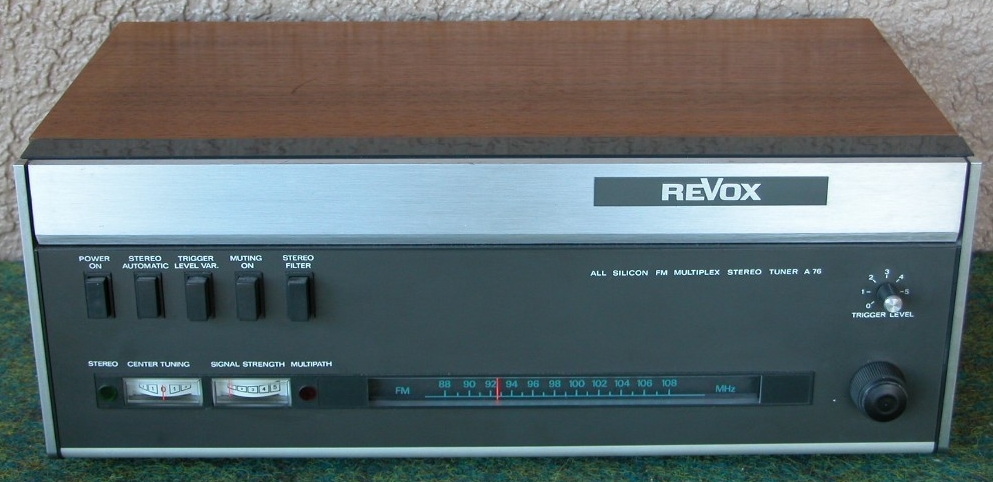
Revox A76 (see below for dates, $750, front1, front2, silver, silver left, right, back, back closeup, with amp, with amp back) search eBay
We don't know much about the A76, an "all silicon" FM-only tuner, but our contributor Paul Baptista did some research: "There are three versions - A76 (1969-1970), A76 MKII (1970-1974) and A76 MKIII (1974-1977). There are some nice inside pictures at this French link which show 4 gangs and uncommon FM detection/demod using two coaxial delay lines and discrete MPX. It looks to me like the makings of a fine-sounding analog unit." Our contributor doug s. says, "I own one of the MKIIs. You will not be disappointed in the sonics. Reception capability is decent but not as good as the best." But our contributor János finds the RF capability of his A76 MKII "very very good, more impressed by the A76 than by, e.g., the Onkyo T-4711."
Our contributor John Byrns says that the Revox A76 is "on the list of tuners I would like to own but don't. The coax lines are used as impedances in a detector circuit similar to the Travis discriminator; they are not used as delay lines as in a true delay line detector such as was used in the Fisher TFM-1000. The multiplex decoder is interesting in that it is a pure sum and difference matrix decoder which uses the response of the 38 kHz band pass filter to provide the 50/75 µS de-emphasis for the difference component. The A76 is the only tuner I know of that used this type of multiplex decoder circuit -- are there any others I don't know of? There is an add-on multiplex decoder box that uses this type of circuit; if I recall correctly it was the Studio 12 decoder. Revox did chintz by not using a balanced difference channel subcarrier demodulator circuit. The result is a high level of the locally reinserted 38 kHz carrier appearing at the outputs of the matrix, necessitating the use of 38 kHz notch filters in the audio outputs to remove the high-level 38 kHz signal." The A76 usually sells for $185-255 on eBay.
Revox A720 (1973, $1,495, front 1, front 2, closeup, back, review 1, 2) search eBay
The A720 was an FM-only tuner/preamp. Our contributor Peter W. says, "I keep two A720s and they are the best tuners I have by any measure under any conditions. The Nixie tube display is no slouch, either. I have had the B760 in the past and compared it directly to the A720 - they are very similar in sound and sensitivity, but the A720 has it all over the other in looks."
Revox B160 (1988, $990) search eBay
We don't know much about the B160, which is the baby of the Revoxes. It usually sells for $270-385 on eBay.
Revox B260 (1988, $2,000, photo, Audio review) search eBay
The B260 and its relatives are big, heavy, well-built digital tuners from Studer Revox of Switzerland that Stereophile and other reviewers have found to be highly sensitive. All the Revoxes have mostly good reputations among audiophiles, but some have called the sound "sterile" (whatever that means). Our contributor Thrassyvoulos praises the B260's "truly fabulous DX potential" but adds, "I have heard three B260s in different high-end systems. IMHO their sound is very thin, too bright and with little body or presence." Our contributor Peter M. reports, "I like the very precise signal strength indicator on the unit (31 bars) and the awesome amount of features it offers. Against stations that are too strong it offers an antenna attenuation switch, attenuating input by 4 dB, selection of the scanning steps at 10/50 kHz, narrow and wide selectivity and blend mode. It allows programming stations [into the presets] with set parameters - station in mono/stereo, antenna attenuation on/off, setting each station input level, station identification input, scanning by programming content, etc. You can also enter the frequency of the station numerically to either store it or listen to it. Talk about bells and whistles - this unit has it all and is well built. The station and frequency indicator even adjusts itself to the room light conditions. The transformer is so big you would expect it in a 100W amp, the circuit boards are cleanly laid out. Operation after one try is very easy - even the programming part. Sound is excellent with good bass reproduction. There is also a remote available." The B260 usually sells for $450-575 on eBay, with all-time highs close to $900. See how one B260 sounded compared to other top tuners on our Shootouts page.
Revox B260-S (1989, $2,500) search eBay
We don't know much about the B260-S, except that it has dual antenna inputs and an astonishing 60 station presets. Our contributor Peter R., who calls the B260-S the quietest tuner he has ever used, points out that station parameters can be programmed into the presets, as in the B260. The B-260 S usually has a silver front panel, but is sometimes seen in black. The B260-S usually sells for $475-575 on eBay, but for those with the optional B208 remote control, the all-time highs are around $1,000.
Revox B261 (1982, $1,500, photo) search eBay
The B261 has many bells and whistles including dials and switches for variable muting and stereo thresholds, variable output, and a choice of auto tuning in 50 kHz or 12.5 kHz (.05 MHz or .0125 MHz) steps. It is one of the few tuners with a headphone jack with volume control, and has manual controls for mono, stereo only, high blend, muting and calibration tone. Our panelist Jim prefers the B261's back-lit LCD display (which can display call letters or station frequencies) to the more common fluorescent display. There is also a matching backlit signal strength and tuning meter. Our contributor Rob says: "The manual says there was a retrofit option to add an A/B antenna switch, which would then be controllable via a front-panel switch. Alas, the parts for this are apparently no longer available - I'm ~25 years too late."
See how one B261 sounded compared to other top tuners on our Shootouts page. While Jim's B261 sample didn't match the performance of his B760, our contributor doug s. feels that the B261 is "every bit the equal of the B760 in all respects." doug adds that the B261 is "pretty much indestructible" and "sounds fantastic. I think it is an awesome performer, and quite reliable. Its sound is stellar, though it could benefit a tiny bit by the use of a tube buffer between it and your preamp, as it is so clean as to be almost sterile. But even straight into a preamp, it is a great sounding tuner. If your system leans towards warm, then this is a perfect match. Its reception is also excellent, and it allows for detuning at 0.0125 MHz intervals." The B261 usually sells for $275-515 on eBay, with highs around $700 when sold with the optional B208 remote control.
Revox B286 (FM/AM version: 1985, $2,300; FM-only version: 1986, $2,200) search eBay
We don't know anything about the B286, a preamp/tuner. If you do, please tell us about it in our FMtuners group. The B286 usually sells for $350-550 on eBay.
Revox B760 (1978, $1,650, closed, open, owner's manual) search eBay
The superbly built, 24-pound, FM-only B760 is one of the few tuners with a headphone jack and volume control. It has two types of muting, each with a variable threshold, and switches for 50/75 µS de-emphasis and Dolby. A handy button that tunes up by 25 kHz rather than the B760's standard 50 kHz steps enables one to off-tune slightly to escape an interfering adjacent channel station. A curious aspect of the B760 is its tuning range that goes down to an unusually low 87.00, allowing one to tune in the audio portion of TV channel 6 (at 87.75) or pirate stations transmitting below the normal FM band. In a side-by-side shootout with the Kenwood L-02T, our panelist Eric found one B760 to be one Kenwood L-02T's equal for weak-signal reception and quieting, even pulling in one weak station in fairly quiet stereo where the L-02T remained in mono. The B760 usually sells for $470-800 on eBay when sold by reputable sellers and guaranteed to work, or as low as $300 or so when sold "as is." The all-time high was $1,225. See how one B760 sounded compared to other top tuners on our Shootouts page, and read our panelist David "A"'s Ricochet.
Rohde & Schwarz search eBay
Our panelist Jim reviews a Rohde & Schwarz tube "relay receiver" and matching transistor stereo decoder on our Tube tuners page. Similar sets have sold for $2,000-3,000 on eBay..
Roksan Caspian search eBay
Our contributor Rick reviews this uncommon minimalist British tuner: "The Caspian is a very simple tuner to use, with just two knobs and two buttons. I also had the optional remote which duplicates functions on the tuner panel. The left knob selects from the fifty channels (presets) available and the right knob is for tuning which is in 10 kHz increments. It will also scan if you spin the knob hard, and will then stop on a reasonably strong station. This unit will not auto scan-and-store as featured on the new ones. The left button is a stereo/mono switch and the right button is a channel store. For RF performance I found it to be good but far from excellent. At my location 10 miles south of Hartford, CT, I get by with a pair of Radio Shack rabbit ears. My two challenging stations are WFCR in Amherst, MA (40 mi) and WSHU in Fairfield, CT (40 mi), with WSHU being the harder to capture requiring a narrow IF bandwidth. The Caspian had no trouble with locals and captured WFCR with full quieting in mono, some noise in stereo. But there was too much noise even in mono on WSHU. I suspect one reason is that the selected single IF is too wide. I paid $365 for it and, just to compare, my Yamaha T-80 (stock, $75), Kenwood KT-5020 and Sansui TU-X1 had no trouble with WSHU. Another tuner that can't receive it is my Fanfare FT-1. The Fanfare has something in common with the Roksan: both are expensive ($1,000+) modern tuners. They must have put most of their money into audio performance because this is where the Caspian excels, with deep bass and a nice richness to the sound. Most of my tuners outperformed the Roksan except in the area of sound, where only the KT-5020 and TU-X1 were better. I sold the Caspian on eBay for $250. For me it wasn't a keeper." Most Caspians we've seen on eBay have sold for around $250.
Rolls RS79B (photo, owner's manual, data sheet, schematic) search eBay
We've been asked periodically why we haven't reviewed any Rolls tuners on TIC. Our contributor Dave O., a broadcast engineer, explains it better than we could: "Rolls tuners seem to find their way into a lot of radio stations. Probably because of the XLR outputs. I've never seen a Rolls tuner that I would rate much higher than 'functional,' and I've seen quite a few that were not even functional (there's a dead one lying on the floor of my shop now). Mostly they seem to get used to feed PA systems for remote broadcasts, and monitoring in remote broadcasting vans. For that purpose, they are just fine. I wouldn't feed the studio monitors with one though... except as a last resort." The RS79B and its siblings usually sell for $50-60 or less on eBay.
Rotel RHT10 (1993, $1,499, photo, owner's manual, technical manual) search eBay
The RHT10, known as the "Michi" (which means "The Path" or "The Way" in Japanese), received good reviews from both audiophiles and DXers. It has 6 gangs and 5 ceramic filters. Our panelist David "A" "would put the RHT10 in about 11th place [out of all tuners] in terms of sound quality (higher if the detector, MPX and audio are totally redone). Getting the best out of the RHT10 requires many changes, and most RHT10s are out of alignment from the factory. So if you own one and like it, send it to a good tuner center for alignment and you'll like it even better. Overall, it's one of the better modern tuners, but on an absolute basis it's not worth the money and effort unless you are a good designer and have lots of time (or money) to play with post-IF mods." Our panelist Jim took a peek inside: "Inside the box, we find a toroidal power transformer, no less than 22 Black Gates, and two large Nichicon power supply caps marked Great Supply. There are no Black Gates in the power supply proper, which is on a separate board. Some ICs include an LA3433, two LA1235s and three 5532s. Finally, there are about 15 polystyrene caps."
Our panelist Bob worked on one belonging to our contributor Ken, putting in different op-amps with Class A JFET bias and custom-selected filters, and Ken reports, "The sound is stunning. I haven't yet had a chance to do my own shootout between the TU-X1, Accuphase T-109V, and the Rotel, but a quick comparison last night favored the Rotel. It is VERY quiet, dynamic, with great bass and imaging - not to mention beautiful sound. Interestingly enough, it sounds very similar to the Accuphase, but may have a very slight edge in dynamics and bass and is quieter."
Bob was lucky enough to play with a second RHT10 and reports that it was "just as good as the first, after alignment and mods. I also own two RT-990BXs; more on the similarities to the RHT10 later. First, the stock factory alignment on the second stock RHT10 was off by a good bit. Can't say too much for the first unit, as someone aligned it 'by ear.' It was in the weeds - totally absurd, but I won't dwell on that. The narrow filter on the RHT10 and RT-990BX is a very unusual circuit, and I don't think anyone has ever really talked about it before, so here is my opinion/analysis. The two tuners are essentially identical, and in both, the narrow IF uses two ceramic filters: a Murata 110 kHz ceramic filter, and some other unknown short, red 3-pin filter. Those two filters, in combination, produce the most horrible 'narrow IF' distortion I've ever seen/measured in a modern stock tuner. These are '90s tuners, so why does the stock tuner in narrow IF measure 1-2% distortion? Those are the full modulation readings I took from a stock RHT10 (narrow, 2%) and RT-990BX (narrow, 1%). All I can say is 2% distortion is clearly audible, and needs to be fixed, in my opinion. My simple mod was to remove the 'red' filter, and replace it with a 230 kHz ceramic filter centered on exactly 10.70, leaving thus a 110 + 230 in narrow. This simple mod lowered the narrow distortion to the more expected 0.2%, while still using the 110 filter for exceptional selectivity. There is hearsay that Don Scott was involved in the selection of the RHT10/RT-990BX narrow filters; if so, all I can say is I disagree with his choices.
"Now that I've mentioned the oddball easily fixed matters, the rest of my report on the RHT10/RT-990BX is very positive. The RF front end is as follows: In the normal setting, there is one gang in front of the RF amp (for 3 total in the RF path). When you engage a front panel selectable control marked 'RF ATT,' the tuner uses diode switches to engage a second gang (for 4 total in the RF path, 2 before and 2 after the single RF amp). So I guess this arrangement gives one the best of both worlds. This sort of design is a great starting point for an RF front end design that has good resistance to strong signal IM and IP3 [intermodulation] problems."
Bob summarized his view of the RHT10 in this later message board post: "I was totally shocked by the RHT10 after doing my first rebuild. It had a sound and reception capability I had never heard before, and I have heard a LOT of tuners. These tuners are incredible machines, engineered great, built poor. The performance is built in, but needs to be released by alignment and filter matching by someone that really knows them. They have a look and feel that makes them instant classics."
Years later, here's Bob again summarizing his RHT10 and RT-990BX mods: "For both units I did the same procedure: Full alignment first, then filter mods. Removing the 'way too narrow and off spec' 110 kHz filter was essential. Installed matched filters for Wide and Narrow. That usually means keeping the stock GDT in Wide, and matching with new filters in Narrow, typically with at least one 150 kHz filter. This is critical for getting low distortion operation in both Wide and Narrow. And being a digital tuned unit, that means both Wide and Narrow need to match the tuner's IF frequency. Then op-amp replacement - OPA604 with healthy class A bias (via FET transistors) on the outputs was the most essential change. This tuner is full of high-end caps from the factory, so no changes needed there. I never touch the metering op-amps, but replaced others in the audio path.
"Also beware of the killer glue around the power supply area - get it out, carefully. On one RHT10, the glue had eaten a small 1/8 watt resistor buried in it, and caused the tuner to stop working. That was an easy fix, once found. If I had a RHT10 here now, I'd hold on to it. But the RT-990BX is pretty much the same thing after mods, less the slightly less nice cosmetics." See Bob's comparison of the RHT10 and RT-990BX in the writeup for the latter. The RHT10 only shows up about once a year, on average, on eBay, and usually sells for $375-675. The all-time highs are $960-1,200.
Rotel RT-725 (1977, $200, photo, inside) search eBay
Our panelist JohnC offers this review: "The RT-725 is styled similarly to the RT-1024/1025 and the RT-2000/2100, though nowhere near their performance level. You start with both 75 and 300 ohm antenna inputs featuring twinlead and PAL connections. A 3-gang, air gap front end feeds 3 (SFE 10.7MA red stripe) ceramic filters, wide-only IF strip into an HA1137 FM IF system IC implementing a quadrature detector. The MPX IC is a Toshiba TA7157P OEM,but listed as a RA1156 on the schematic. De-emphasis is an internally switched (50/75 µS) passive affair, with one gain stage and no buffer in the audio output. The unit features both fixed and variable RCA outputs. The front panel houses the power switch, Output Level, Function, High Blend and Muting switches, along with tuning and signal-strength meters. Feed it a good signal and it sounds surprisingly good and is reasonably quiet. Mods, though pretty straightforward, are somewhat hampered because there are absolutely no component IDs on the board. Build quality is just fine, but what catches your eye is the yellow dial and meter lighting, like the RT-1024/25." Our panelist Bob points out that the RT-725 was third in Rotel's lineup in 1977 behind the RT-1024 and the scarce RT-925 (1977, $340), which had specs that more closely rivaled the RT-1024's.
Rotel RT-830A (1989, $200, front, back) search eBay
The RT-830A is a low-profile analog tuner with a tiny tuning capacitor, 3 FM gangs and 2 ceramic filters. It lacks a center-tuning meter, its signal-strength meter is 5 LEDs, and muting and stereo/mono are on the same switch (meaning you can't choose to listen to a weak FM station in slightly noisy stereo). The surprise is a sensitive, astoundingly selective and excellent-sounding AM section! We're not sure how Rotel did it, particularly since the RT-830A has only 2 gangs for AM, but the AM noise filter button shows that they were serious about it. While the tuner's FM performance is run-of-the-mill, its AM was almost good enough to get our panelist Eric to start DXing AM again. We'll have to investigate whether any other Rotels from that time period might share the same great AM section while offering superior performance on FM. The RT-830A and the presumably similar RT-830 (front, back, owner's manual, search eBay) sell for $30-50 on eBay.
Rotel RT-850 (front, back, inside, owner's manual) search eBay
and
Rotel RT-850A (front, left, right, back) search eBay
The RT-850 and RT-850A are low-profile black digital tuners that may have been the successors to the RT-830 and RT-830A. The RT-850A's front panel is identical to the RT-850's and we don't know what internal differences there may have been. Like the 830s, the 850s lack a center-tuning meter, their signal-strength meters are 5 LEDs, and muting and stereo/mono are on the same switch (meaning you can't choose to listen to a weak FM station in slightly noisy stereo). We'll speculate that the 850s have good AM sections, like the 830A, because the 850s' front panels include an "AM Wide" button. The RT-850 and RT-850A usually sell for $40-60 on eBay.
Rotel RT-860 (schematic) search eBay
Our contributor Sam tells us that the scarce RT-860 is identical to the Amber Model 7, except for "some repositioning of the front buttons" on the Amber. Our contributor Dave P. reviewed the RT-860's service manual, available at HiFiEngine.com, and said, "The RT-860 appears to use a discretes-on-the-main-board FM front end, rather than one of the prepackaged front-end cans/modules. The internal design of the front end looks straightforward. Other than that, the RT-860 design looks quite similar to the RT-1010: a single PLL chip with a prescaler which operates in FM mode, single-transistor IF amplifier followed by two ceramic filters and a FM amp/limiter/detector IC, an IC multiplex decoder, controller, display drivers, power supply."
Rotel RT-870 (inside and outside photos) search eBay
The RT-870, Rotel's top-of-the-line tuner before the RT-990BX and RHT10 came along, apparently has a similar if not identical front end to those two superb tuners (it does have a different output stage). The RT-870 has 6 gangs, 4 ceramic filters, and wide and narrow IF bandwidths for both FM and AM. It has a fully discrete output stage, and about 30 polystyrene caps in total. Sensitivity and selectivity are both reportedly very good. Our contributor Stephen, who at one time owned three RT-870s, said: "No other tuner has performed sonically as well as the RT-870 in my system. I have not owned an RT-990BX or RHT10, but I have owned two different RT-2100s, Yamaha T-85, TX-1000, TX-950/930/550/530 and T-1000, Sansui TU-717/517 (several), Pioneer TX-9500II and 8500II, Kenwood KT-8300, McIntosh MR 71, 77, 78, 80, and 7083, NAD 4300, and many others I can't recall. I am sure the RT-870 would be close in performance to the RT-990BX or RHT10 just based upon how well it has compared to other tuners. There is something about the openness and musicality of the 870 that I find most appealing. I have had other tuners with better bass, but I tend to favor a more open midrange. I have had many A/B sessions, and even my wife, who really lacks a trained ear, can easily pick the 870 over the other tuners when directly compared. This is my favorite tuner that doesn't break the bank, and the one tuner I have enjoyed listening to the most."
Rotel RT-970BX (owner's manual) search eBay
Our contributor Stephen, quoted above in the RT-870 writeup, says: "I now have an RT-970BX and it's just like the 870. Same board and front end, but chock full of Black Gates, unlike the 870 which was not. A bit more open on the midrange and top end with a bit more bass, but perhaps a bit too bright as a result at times. But both Rotels, IMO, have much better sound then a Yamaha TX-1000U (and many others) and are slightly more sensitive and selective. One thing worth mentioning: Both the 870 and 970 have extremely high output levels. I have only found a few other tuners with variable ouputs that can come close, but none with fixed outputs have equaled the Rotels' output. When listening and comparing, the tuner whose playback level is louder usually sounds better than the other at a lower playback level. With that said, I still feel that the Rotels sound better, even when compared at a lower playback level then the other tuner at a louder playback level, which IMO is an even bigger feat then the usual side-by-side at equal level comparisons."
Rotel RT-990BX (1993, $750) search eBay
The FM-only RT-990BX is almost as good as the very similar RHT10 at a much lower price, according to our panelist Bob (see Bob's review of the RHT10 above). It is not as rare as the RHT10 and usually sells for $175-340 on eBay. It has a remote control, which is required to access the 16 presets, but Bob says the RT-990BX sounds so good that it is worth buying even without the remote. In addition to the presets, other front-panel controls are stereo/mono switch, RF attenuator, wide/narrow bandwidth selector and signal-strength indicator. Our contributor David Rich notes that the RT-990BX has a double-tuned filter at the antenna and is double-tuned after the RF amp. Our contributor Robert C. agrees with Bob's sonic assessment; his RT-990BX has "great sound: rich, full, sonorous, detailed. I got one on eBay four or five years ago and it has been in my main system almost continuously ever since." Robert adds, "I found one of the strengths of this tuner to be the lower midrange clarity and force - think cellos in an orchestral mix. For the first time, this was a tuner that had it, along with everything else frequency-wise that you want to hear."
Here's Bob's comparison of the RHT10 and RT-990BX: "The RHT10 and RT-990BX are essentially the same tuner, with major cosmetic and minor parts and circuit differences. They use the same remote control codes, although again, the remotes are different in appearance. They also use the same circuit board and parts designations on the board, although the boards are different in color. The RT-990BX is missing parts in one area, where the stereo blend circuit is implemented. They have the same RF front end and sine wave type stereo MPX circuit. Alignment procedure is the same for both. Here is a list of functional differences I've compiled:
RHT10/RT-990BX
Power Cord - IEC three-prong receptacle/standard dedicated two-prong cord
Transformer - potted round/potted square
stereo blend - yes, front panel/no stereo blend
RF signal level - numeric, 1-7/5 LED bars to indicate level
output op-amp - AD847/NE5534
audio circuit resistors - "boutique"/standard metal film
Black Gate caps - yes/yes, same number and type
For looks alone I prefer the RHT10; it is one of the best-looking tuners ever made, in my opinion. But they are extremely rare, so rest assured, you are getting in essence the same tuner, less a few fancy resistors, if you buy the more common RT-990BX."
Our contributor Bill C. tells us about his RT-990BX, which was slightly modded with new op-amps and the like: "This tuner is no audiophile pretender, it is the real deal. This is a very quiet tuner with just a luscious sound from bass through mids to highs. Stereo imaging is great with a very non-fatiguing sound. Until I do closer comparisons, this tuner ranks in my top five for sound quality, going up against a modified Accuphase T-100, modded Sansui TU-9900 and Pioneer TX-9500II, modded Yamaha CT-7000, and highly modded HK Citation 18 and Mitsubishi DA-F20 among others. All this and I have spent less on this Rotel and sometimes a lot less than on these other tuners. If you have a chance to get an RT-990BX, you probably can't go wrong. The only slight negative, and I realize this is very subjective, is that this tuner is nothing to look at. It's a basic black box, period. But close your eyes and listen and it really impresses." Our contributor doug s. adds, "The only thing I didn't like about the RT-990BX is that it doesn't have a hi-blend circuit. If you have a station that's borderline, and sounds nice in stereo only with the hi-blend engaged, you're out of luck with this one."
Rotel RT-1024 (1976, $570, photo) search eBay
The RT-1024 has 5 gangs, 4 filters, and a discrete output stage (no op-amps) that produces excellent sound according to some contributors. Our contributor Ben says it's one of his 3 favorite tuners, along with a Marantz 2130 and a Kenwood KT-8300. The RT-1024's unusual onboard Dolby processing circuit, originally intended for decoding broadcasts in the now defunct Dolby FM system, allows it to be used with tape decks as a general purpose outboard Dolby processor, for both recording and playback. This function is totally independent of the tuner circuit. The RT-1024 usually sells for $200-325 on eBay.
Rotel RT-2000 (1979, $430 or $460, photo) search eBay
The RT-2000 is a large 4-gang tuner with wide and normal IF bandwidth settings, servo-lock tuning, and a tuning meter that doubles as a multipath meter. Contrary to what one forgotten contributor suggested, our panelist Ray doubts that the 2-gang AM section is anything special. The RT-2000 can sell for anywhere from $40-60 to well over $100 on eBay.
Rotel RT-2100 (1979, $600 or $640, photo, schematic, owner's manual, Audio review) search eBay
The scarce RT-2100 is a 5-gang, rack-mount, FM-only analog tuner with excellent sensitivity. It has wide and narrow IF bandwidth settings, a multipath meter, some sort of quartz lock tuning circuitry, an output level control and recording check switch. It can have either a black or silver case and has a digital readout as well as an analog dial. The RT-2100 usually sells for $100-160 on eBay.
Here's our panelist JohnC's review: "I recently got to go through one of my long term 'wants,' an RT-2100. First a quick rundown on the hardware. If you track one down you are rewarded with an ergonomically pleasing layout. Dual-bandwidth IF, a manually defeatable quartz tuning lock for the DX types, which is automatically defeated when you touch the nicely weighted tuning knob. A dual-purpose, 7-segment LED signal strength/multipath indicator, recording calibration tone and High Blend switches are also provided. The center-tuning indicator consists of 3 LEDs, Low, High and Tuned, very similar to the indicator on the Mitsubishi DA-F20 which is elegantly simple and effective. Variable Output adjustment, Muting/Lock, Mode switch and Wide/Narrow IF complete the front panel. The back panel houses Fixed, Variable, and Detector outputs, along with the usual antenna connections and an auxiliary power receptacle. The chassis has a fully removable bottom panel, but some components are blocked by a second board stacked above the main PCB -- more on that later.
"The RT-2100 has a 5-gang front end incorporating 3 MOSFETs. In fact, it uses the same front end as the Sansui TU-919, a pretty good way to start. The Wide IF strip incorporates 3 blue ML series Murata ceramic filters and the Narrow uses 5 ML CFs, both using 3 IF amps, one TA7060P and two LA1222. The IF IC is an LA1231 feeding an HA11223 MPX IC. The board seems to be able to handle both the 11223 and 11223W ICs. This one used the W variant. Audio output is implemented using discrete components run in balanced mode and employs FETs, if I'm reading the schematic correctly. That's probably why it sounds good, and it does indeed sound very good. This whole thing is fed from a board isolated, balanced, regulated power supply and a nice large transformer.
"Without touching anything the sound is captivating. This tuner has one of the best soundstages I've heard. Excellent separation and great depth are the order of the day. Very few tuners here can compete with the sound field that the RT-2100 can generate. The bass needs a little help, but not much, and the highs are very nice as is. The RT-2100 impressed me so much that I delayed writing this review, just to make sure I wasn't just infatuated with a new toy. It's been playing for 12 hours a day, 7 days a week, and I've never found the sound irritating or labored -- no listener fatigue here. Did I mention how wide and deep the soundstage is, or how good it sounds? One of a handful of great sounders, IMHO." Our contributor Marc called his RT-2100 "a keeper," preferring it to a roster of other good tuners that included Accuphase T-100, T01 and T106, McIntosh MR 74, Meridian 604, Philips AH-6731 and Revox B760.
Continue to Tuner Reviews S-Z
|